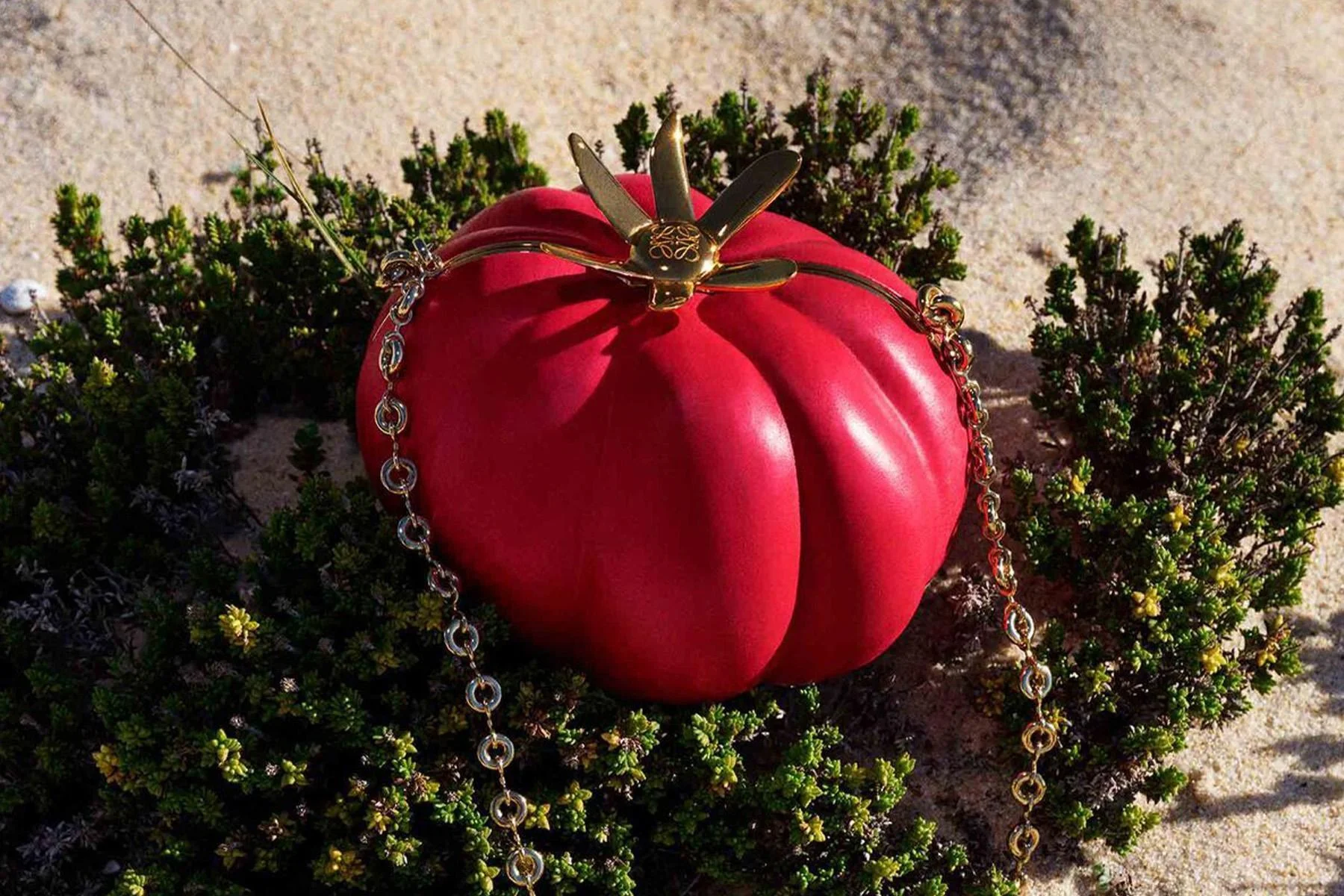
A tomato clutch priced at $4,150 and a rotisserie-chicken purse starting at $5.97 tell the story of food-themed fashion better than any trend forecast: the motif has crossed from luxury novelty into mass-market shorthand. The question now is whether designers can make it mean something beyond a quick laugh or a social media post.
Loewe’s lambskin tomato clutch appeared in its summer collection; Walmart offered chicken-shaped bags and charms. Between them sits a crowded market of food prints, snack-shaped accessories and trompe l’oeil objects. What once made a baguette-shaped purse feel sly now competes with Moschino’s celery bag and a Big Bud Press jumpsuit covered in hot dogs, beer, wine and pretzels, made with a Los Angeles bar.
The spread has followed a familiar fashion path: a striking runway idea catches attention, then variations reach shoppers at a range of prices. But food imagery has had particular staying power because it carries more than visual novelty. It can signal taste, nostalgia, belonging and, increasingly, money.
From runway joke to personal identity
Puppets and Puppets helped establish the current wave in 2020, when a chocolate chip cookie jutting from a black handbag became one of New York Fashion Week’s most talked-about details. The brand built on that absurdist premise with cake-topped aviator caps, Ferrero Rocher heels and cheese hats sculpted from beeswax. Each object was designed to be seen, photographed and shared.
Before entering fashion, designer Carly Mark made art around candy and snacks. In a 2023 interview with Business of Fashion, she described food and fashion as fields driven by pleasure and money. That pairing helps explain why the image of a snack on a bag can feel both playful and commercially astute.
The pandemic years widened the audience. The strawberry dress became a TikTok fixture, while Tombolo Company’s vongole shirt, introduced in 2019, reached its peak popularity in 2021. Food also became a way to display allegiance: Katie Kimmel’s chicken-parm shirts treated dinner preferences with the fervor of team merchandise, and Rachel Antonoff’s seafood-tower dress helped make “seafood kitsch” a defining look of summer 2022.
These pieces work because food preferences are unusually legible. A favorite taco shop, a regular martini order or a fast-food staple can tell other people where someone likes to go and what they value. Cole Poska, a content creator and partner and creative director at Beyond Studios, says food companies have “decades of nostalgia, iconic identities, and consumers who are borderline obsessed with them.”
Poska’s own playful designs for Cheesecake Factory apparel went viral, including a hat shaped to resemble the chain’s brown bread. He argues that people’s loyalty to a food brand can be as intense as their attachment to a favorite restaurant or order. Wearing those references turns private preferences into a public statement.
When the joke becomes ordinary
That statement is losing some of its surprise. Bon Appétit asked in 2024 why so many dresses featured pasta and cocktail shrimp. A shrimp-print dress once stood out; now food motifs appear so frequently that the reference itself may be doing less work.
The problem is tied to the pace of online trends. Products built to attract attention can spread quickly, then feel dated before they’ve earned a place in anyone’s wardrobe. When an accessory relies on shock value and a recognizable food shape, its usefulness and identity as a brand can matter less than its ability to circulate in a feed. That makes a short product cycle more likely—and can leave another disposable object behind.
There’s also a sharper edge to food as a fashion signal. As food prices rise, wearing an oyster-covered $425 cardigan can read as evidence of comfort and access, as well as a taste for the unusual. A caviar sweater makes luxury dining part of the wearer’s identity. Meanwhile, a mass-market tomato purse can borrow the same visual language without the same price tag or associations. Food clothing may look lighthearted, but its meaning changes with who can afford the references and where they come from.
The motif’s history makes the current glut easier to see. In the 2000s and 2010s, “foodie” culture brought avocado and coffee slogans to casual clothing. Those graphics turned eating into an identity marker. Today’s bags and garments make the idea more literal: instead of declaring affection for a dish, they reproduce it on the body.
Utility and storytelling as an alternative
Some labels are finding a quieter way to make the connection. Meals, a Los Angeles workwear-inspired apparel company co-founded by Sam Salad, puts food references into practical garments. Its chef pants come in basic colors as well as restrained nods to blue cheese and watermelon. The food idea is there, but the cut and function still give the clothes a reason to exist beyond the joke.
Salad started Meals in 2019 after selling premium denim on Abbot Kinney Boulevard in Venice, surrounded by restaurants and the social culture built around them. “Design today has to translate across languages and platforms,” he tells Eater. That can mean making an idea recognizable online while still producing something a customer will wear offline.
Food and fashion have met before, and the most enduring examples drew their force from more than a literal food shape. Salad points to Issey Miyake’s pleats merchandised as small omakase sets and to the 1937 lobster dress designed by Salvador Dalí and Elsa Schiaparelli. Worn by Wallis Simpson, the dress challenged expectations of conventional dress. Its later mass-market copies show how a bold original can lose its context as the image gets reproduced.
“Food brands have something most brands would kill for: decades of nostalgia, iconic identities, and consumers who are borderline obsessed with them.”
Cole Poska
The path out of food-fashion fatigue may depend on resisting the urge to turn every recognizable ingredient into another product. Salad’s benchmark is In-N-Out Burger: a company that, in his view, succeeds by doing a small number of things well. Poska puts the design challenge plainly: “I’d rather make one thing people talk about for a year than 20 things people forget about tomorrow.”
A butter-shaped bag or candle can still be memorable. But once every label is selling its own edible punchline, novelty alone stops distinguishing the work. Utility, quality and a story that holds up beyond the first post offer a better test of whether food fashion can last.