From pop-up to permanent address
Alfie’s has made a Georgetown alley its permanent home, bringing northern Thai cooking and a tightly limited steak frites special to Washington, D.C. The restaurant’s path to a permanent address has been less conventional than a simple neighborhood opening: chefs Justin Ahn and Alex McCoy launched it as a Petworth pop-up in 2017, took it to New York and London, and settled in Georgetown this year. That history gives the restaurant a different starting point from a kitchen built around a fixed dining room from day one.
A pop-up can let a restaurant test its identity in changing settings, but a permanent home asks more of the idea. The food has to make sense night after night, and guests need a reason to return beyond the novelty of a new address. Alfie’s appears to be staking its case on a specific combination: northern Thai dishes, ingredients from the DMV, and a steak special whose small nightly run makes it a distinct part of the menu. There’s a clear point of view here, though the restaurant’s consistency will ultimately matter more than its itinerary.
The menu draws on Thai techniques while using ingredients from the DMV. That pairing can be more than a sourcing note. It puts the kitchen’s work in conversation with the place where it’s now based, while keeping the cooking rooted in a regional Thai tradition. The source doesn’t specify which local ingredients appear in which dishes, so the broader idea is the useful one: Alfie’s is adapting its cooking to its current home without presenting the menu as a generic take on Thai food.
A steak special with a Thai accent
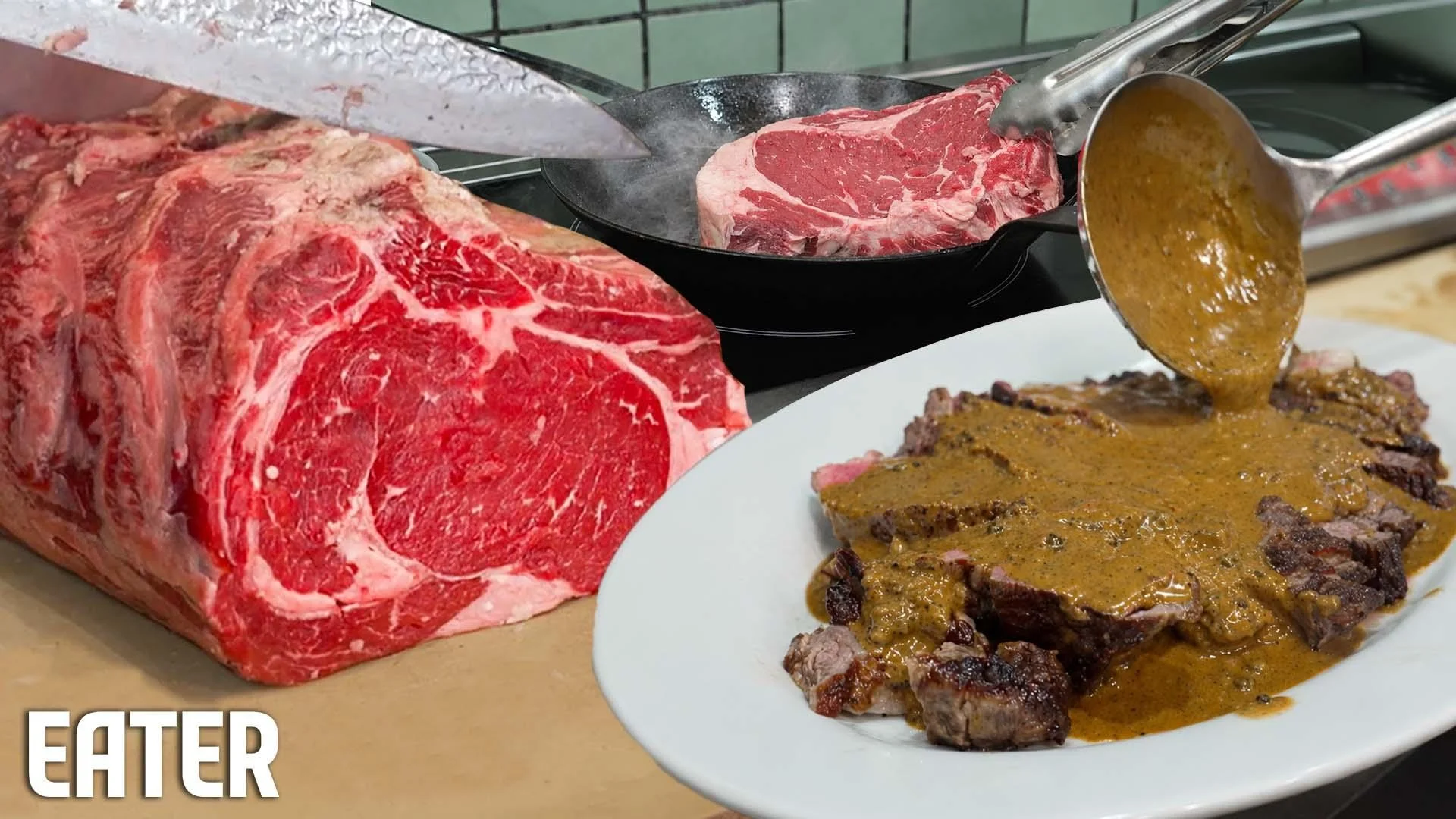
Only five orders of the steak frites are made each night. The limit gives the dish a defined place in the kitchen’s workload, and it also means the special can’t be treated as an unlimited alternative to the Thai dishes around it. The kitchen breaks down 26-ounce rib-eyes and sears each steak to order, then finishes a massaman curry peppercorn sauce in the pan with the remaining beef fat. That’s a Thai-inflected take on steak au poivre, served with classic bar fries.
The method links the sauce to the steak instead of treating it as a separate topping. Beef fat carries the flavor left in the pan into the massaman and peppercorn elements, while the fries keep the dish recognizable as steak frites. This is more significant than it looks: the special’s appeal rests on a clear exchange between familiar form and the kitchen’s Thai influences, rather than on an unfamiliar presentation for its own sake.
Five orders is a firm constraint. It may help the kitchen give each steak individual attention, but it also makes availability part of the experience; diners who arrive expecting to order it may find that the night’s supply is gone. That scarcity can create interest, yet it doesn’t tell us whether the dish will become a lasting signature. The more useful question is whether the limited run supports the rest of the menu and reflects how the kitchen wants to cook.
Hands-on Thai cooking
Green papaya salad demands careful work at the line. Chefs slice the fruit by hand and toss it to order with tomatoes, peanuts, and a punchy dressing built around palm syrup and tamarind. Ko calls it the kitchen’s “most labor intensive dish on the line.” That description points to a practical choice: the salad’s preparation happens close to service, so the team can finish each serving when it’s ordered rather than relying on a fully assembled dish waiting in advance.
That work matters because the salad depends on the ingredients meeting in balance. The papaya provides the base, while the dressing brings palm syrup and tamarind into the same preparation as tomatoes and peanuts. The source describes the dressing as punchy, but doesn’t give a recipe or precise proportions. There’s no need to invent them; the important detail is that a dish that might look simple on the plate calls for hands-on preparation and attention at the line.
A pot of gaeng hung lay simmers nearby. The northern Thai pork belly curry cooks until its large pieces develop a rich, fatty layer; pickled garlic and pineapple cut through the curry paste, tamarind, and fish sauce. Before service, the team prepares herbs and steams sticky rice that’s soaked overnight. The contrast between the slow cooking of the curry and the last-minute preparation of the salad shows how different kinds of labor shape a single service.
The curry also makes clear that the kitchen’s work isn’t limited to adding heat or a signature sauce. Pork belly, curry paste, tamarind, fish sauce, pickled garlic, and pineapple all have roles in the finished dish, and the rice has its own preparation well before it reaches the table. (And this is the part most people overlook.) A restaurant’s identity often comes through in that less visible work: the timing, prep, and judgment that allow dishes with different methods to arrive as part of one meal.
A restaurant built around the experience
McCoy describes cooking as a lifestyle, with its reward coming when diners enjoy the work each night. He wants Alfie’s to give guests room to forget where they are and lose themselves in the food and experience. That’s an ambitious aim, but it’s also a useful standard against which to judge the menu: the careful salad preparation, the curry’s long simmer, and the steak’s limited availability all ask the guest to pay attention to how the meal is made.
Here’s the thing: a restaurant’s stated philosophy only carries weight when the cooking makes it tangible. Alfie’s has a persuasive premise in its mix of labor-intensive Thai staples and a five-portion steak special, because the dishes described here show different expressions of the kitchen’s approach. Yet no single dish can stand in for the whole experience. The restaurant’s ambition will depend on whether those distinct parts work together across an ordinary evening.
If you’re working in this space, the balance is familiar: a kitchen needs a point of view, but it also needs to deliver that point of view reliably through service. Alfie’s description offers glimpses of how the team handles that challenge, from making green papaya salad to order to preparing sticky rice in advance. And yet. The account doesn’t establish how the restaurant handles every part of a busy night, and it doesn’t need to. It gives a closer look at the cooking choices that define this particular menu.
What this means for you as a diner is straightforward: the restaurant is asking you to see the steak frites and Thai dishes as parts of the same project, not as competing identities. The steak borrows from massaman curry and peppercorn sauce; the salad and gaeng hung lay reflect distinct preparation and flavor combinations. Whether that mix becomes a lasting draw will depend on the meal itself. For now, the kitchen’s ambition is visible in the work it puts into each dish.
The kitchen’s mix of labor-intensive Thai staples and a five-portion steak special offers a clear picture of that ambition. Watch the Alfie’s team cook in this episode of Now Open.