This review contains spoilers for You Can See Everything.

A version of this post originally appeared in Eater Today, which spotlights the freshest news and stories from across the food world every day. Subscribe now.
A bowl of eggs becomes one of the sharpest tests of perception in You Can See Everything, Nathan Fielder and Lance Oppenheim’s nearly three-hour documentary about Elizabeth Holmes. The scene is ordinary on its surface: Holmes starts beating eggs with a fork, and her partner, Billy Evans, reaches in and takes over. But the small gesture opens a larger question the film keeps pressing: who has control, and how much can a viewer actually know from watching?
A breakfast exchange with consequences
Fielder and Oppenheim filmed Holmes and Evans in their rental home during the final weeks before Holmes was due to report to federal prison. Holmes presents herself as a person misunderstood by the public, and as someone whose intentions during the Theranos years were fundamentally good. The film gives that account space to breathe, including quiet domestic scenes that can make her seem more vulnerable than the familiar image of a calculated fraudster.
Then comes breakfast. While Fielder speaks with Holmes, she mixes the eggs without much force. The camera holds on her hands. Evans’s hands enter the frame; he takes the bowl and fork and whips the mixture himself. He doesn’t ask first. Holmes doesn’t object. When Fielder asks why Evans intervened, Holmes says he dislikes how she mixes eggs and believes he can do it better.
Couples often correct or assist each other in the kitchen. Taking an object directly from a partner’s hands is a different kind of move, and the camera makes it hard to dismiss as background business. Evans appears at ease assuming control. Holmes appears used to explaining the arrangement. That interpretation is suggestive, though it isn’t proof of anything beyond what the scene shows.

The scene also resists a clean reading of Holmes. Is she simply poor at the task? Is she choosing not to do it well because she expects Evans to step in? Or is Evans imposing his preferences on her? The film leaves all three possibilities open. That ambiguity is its method: a gesture can look like care, condescension, strategy, or habit, depending on what the viewer brings to it.
Holmes’s account meets the film’s record
In interviews, Holmes describes her time at Theranos as a period shaped by manipulation from Sunny Balwani, her former boyfriend and business partner. She says she wanted the company’s work to help humanity, even as investors were defrauded and patients received unreliable test results. The film doesn’t settle whether she believes this version of events or knows how to make it persuasive. The distinction matters, but the documentary supplies no easy way to resolve it.
Holmes’s history invites competing explanations for her relationships and decisions. She may have been controlled by men around her; she may have participated in choices that served her interests; both could be true in different ways. The breakfast scene brings that uncertainty into a domestic setting, where the stakes look smaller but the behavior is easier to inspect.
Evans’s public role shifts as the documentary proceeds. Early on, he can seem protective and somewhat naïve. After Holmes is imprisoned, the film reveals that he has power of attorney and has used her X account to publish profanity-laced posts that sound unlike her. Those details recast the earlier interruption at the stove. What first looked like a fussy partner taking over a task can now register as a glimpse of a broader imbalance.
Other reported actions deepen the unease. Evans has licensed Holmes’s image for billboards tied to another entrepreneur’s fixation on Theranos. He also appears willing to entertain the use of an AI-generated likeness of Holmes for pornography or other material that could run against her interests. The film raises questions about whether Holmes knows about or approves of these choices. It can’t answer them from the evidence it presents.
Three unreliable perspectives
The documentary’s tension comes from the gap between what people say and what they do. Holmes says she has never lied. Evans tells Fielder that he and Holmes never fight. Their actions, expressions, and public conduct complicate those claims, but don’t automatically disclose an underlying truth. As viewers, we are left weighing statements against behavior without knowing what either person would admit privately.
Fielder belongs inside that uncertainty, too. His work often focuses on mundane details that later acquire a different charge, and You Can See Everything turns that approach toward a story already crowded with performance. He can keep a straight face through situations that seem designed to test his sincerity. The film’s unusually close attention to Holmes and Evans doesn’t mean the filmmaker is a transparent observer.
Several moments invite speculation about whether Fielder feels a personal or sexual attraction to Holmes, and whether anything he might do would be sincere or part of a constructed performance. The film doesn’t settle that question either. His presence becomes another source of doubt: the person recording the scene may be shaping it, even as he appears to watch from the edge.
That uncertainty fits the documentary’s broader structure. There is Holmes’s account of her past, Evans’s conduct in the present, and the future they may be pursuing. The film points to the possibility of a new venture, Haemanthus, described in a New York Magazine report as a potential Theranos successor. Each thread changes how the others look, but none produces a definitive explanation of the people at the center.
Watching isn’t the same as knowing
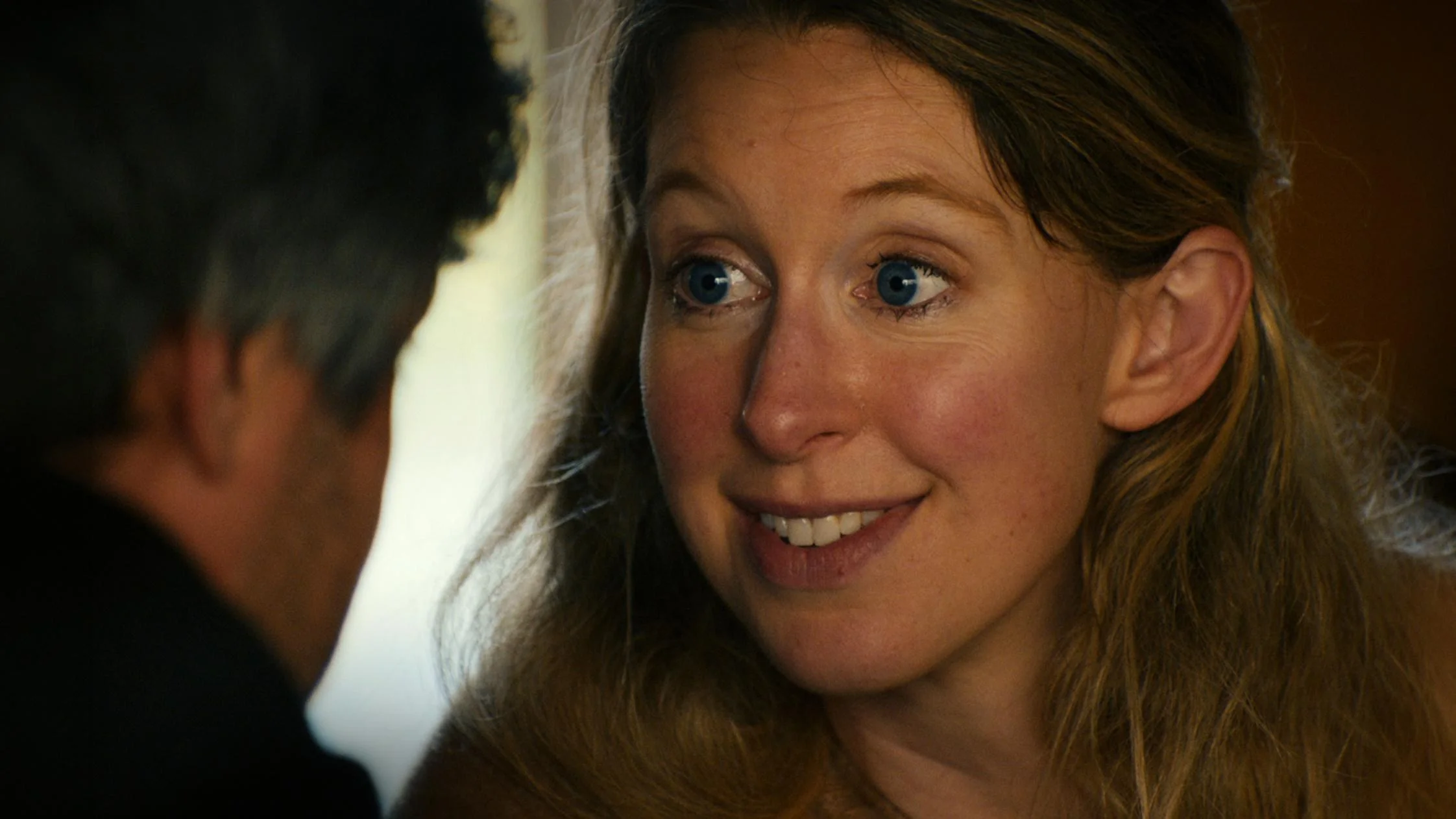
The film’s close-ups encourage viewers to search faces for evidence: a twitch, a pause, a look exchanged across the table. Those details can feel like access to a private truth. Yet facial expressions are easy to overread, especially when the surrounding story has trained us to expect deception. The documentary makes observation feel powerful, then shows how quickly interpretation can outrun what is actually on screen.
The egg exchange captures that problem in miniature. Evans takes over; Holmes lets him. That much is visible. Whether the moment reflects domination, mutual understanding, tactical helplessness, or a routine household habit remains beyond the camera’s reach. The scene matters because it makes those possibilities feel plausible without selecting one for us.
Fielder and Oppenheim turn a domestic interruption into a lens for examining how people manage appearances and power. You Can See Everything may offer unusually intimate access to Holmes and Evans, but proximity doesn’t make them legible. Its clearest takeaway is also its most unsettling: even when the camera catches a revealing gesture, the meaning can shift as new evidence comes into view. The next time the film returns to an apparently minor detail, viewers have reason to look closely—and to stay wary of what they think they’ve seen.